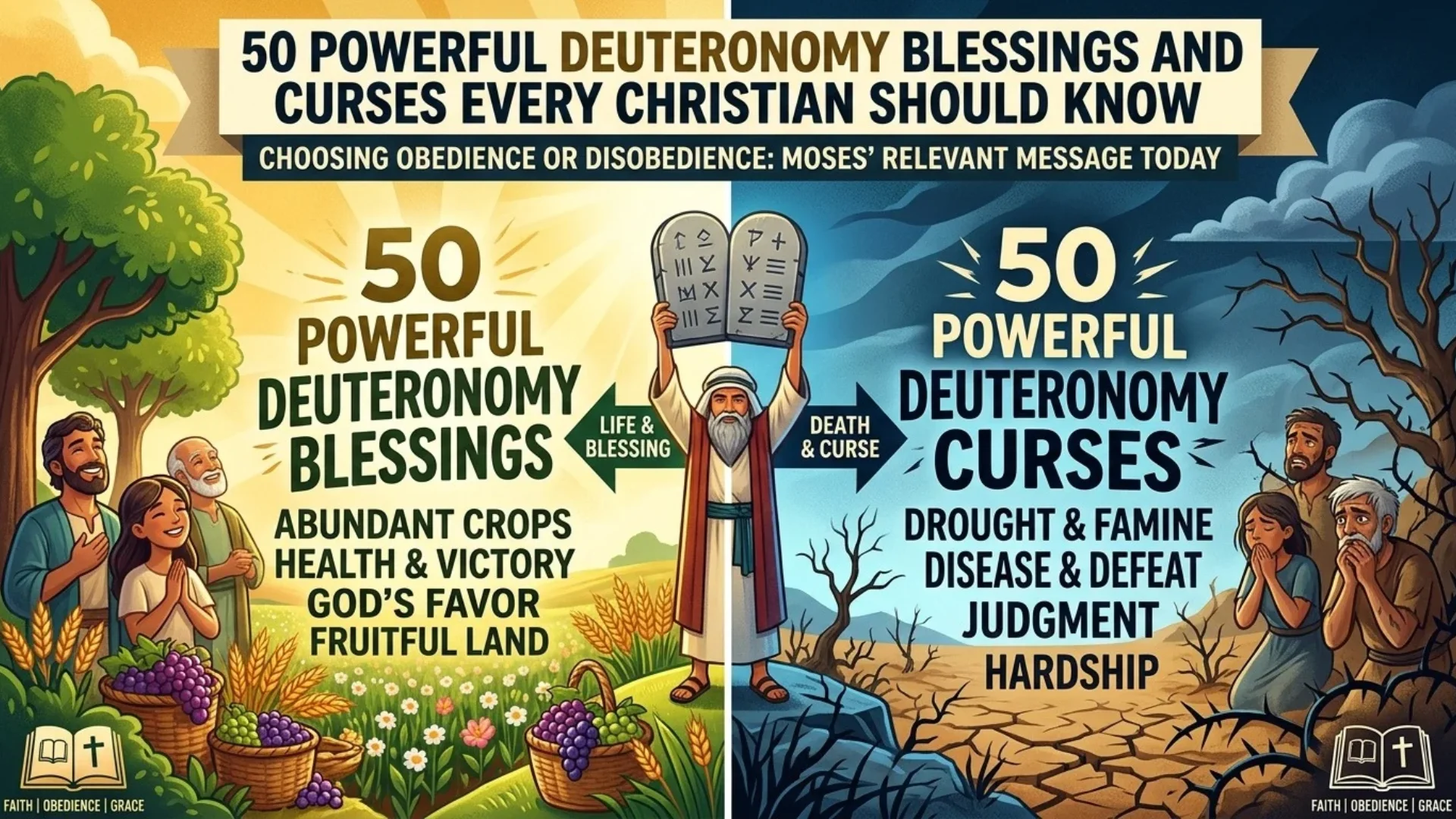
Moses gave Israel a clear choice: obey God and be blessed, or turn away and face the curses of disobedience. The Powerful Deuteronomy Blessings & Curses in chapter 28 still shape how Christians read the Bible.
Here are 50 of them, in plain words, with the verse for each. You will also see what they meant then and how believers should read them now.
Table of Contents
What Are the Deuteronomy Blessings and Curses?

The Deuteronomy blessings and curses are the covenant promises and warnings Moses gave Israel before they entered the Promised Land. They sit mostly in Deuteronomy 28, which has 68 verses. Verses 1–14 list the blessings, and verses 15–68 list the curses. That means the warnings take up about four times more space.
Moses spoke to a new generation. Their parents had made the covenant at Mount Sinai about 40 years earlier. Now the children stood on the plains of Moab, ready to renew it.
The chapter builds on Deuteronomy 27. There, tribes stood on Mount Gerizim and Mount Ebal to speak blessings and curses aloud. Chapter 29 adds the Moab covenant, and chapter 30 ends with hope and the call to “choose life.”
The format was familiar in Moses’ day. Ancient kings, such as the Assyrian ruler Esarhaddon, wrote treaties that ended with long lists of curses. Moses used a similar form, but with one big difference. Israel’s covenant was with a God who also offered grace and restoration.
Readers of the Deuteronomy blessings and curses KJV will notice older wording. The KJV says this about the first blessing: “Blessed shalt thou be in the city, and blessed shalt thou be in the field” (Deuteronomy 28:3). Newer versions say it in plainer English. The meaning is the same: God’s favor covers every part of life.
20 Deuteronomy 28 Blessings of Obedience (Deuteronomy 28:1-14)
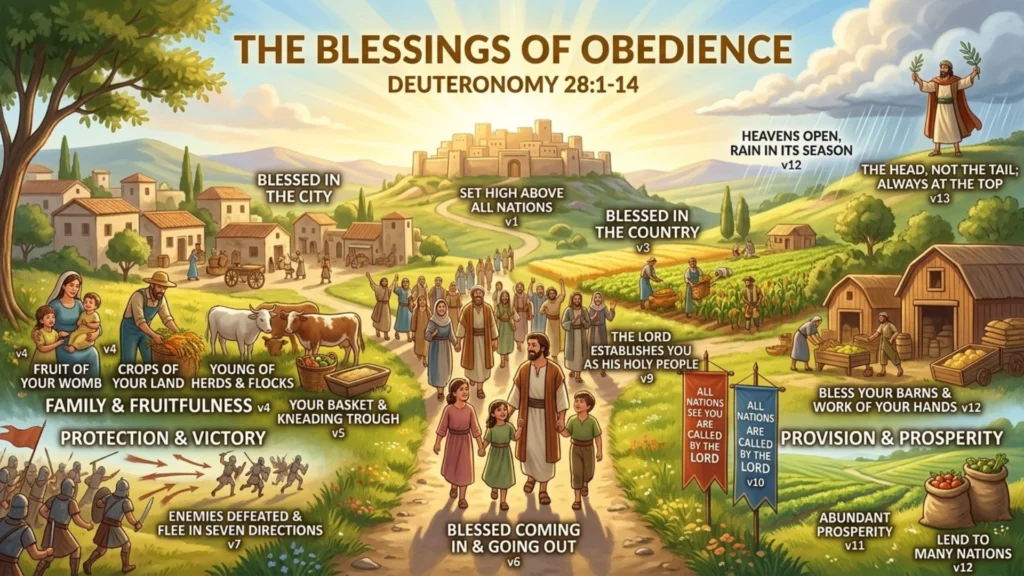
The Deuteronomy 28:1-14 blessings promise God’s favor to a people who listen to Him. Each one below is short and easy to remember.
These first blessings cover position and favor. They show how God would set His people apart.
- You will be set high above all the nations of the earth. (Deuteronomy 28:1)
- You will be blessed in the city and blessed in the country. (Deuteronomy 28:3)
- You will be blessed when you come in and blessed when you go out. (Deuteronomy 28:6)
- The Lord will establish you as His holy people. (Deuteronomy 28:9)
Next come blessings of family and fruitfulness. In a farming world, children, crops, and herds meant security.
- The fruit of your womb will be blessed. (Deuteronomy 28:4)
- The crops of your land will be blessed. (Deuteronomy 28:4)
- The young of your herds and flocks will be blessed. (Deuteronomy 28:4)
- Your basket and your kneading trough will be blessed. (Deuteronomy 28:5)
Then comes protection and victory. God promised to guard Israel from threats.
- Your enemies who rise against you will be defeated before you. (Deuteronomy 28:7)
- They will come at you from one direction and flee from you in seven. (Deuteronomy 28:7)
- All the peoples of the earth will see that you are called by the name of the Lord. (Deuteronomy 28:10)
- The Lord will bless your barns and everything you put your hand to. (Deuteronomy 28:8)
The next group covers provision and prosperity. These show God as a generous provider.
- The Lord will give you abundant prosperity in your land. (Deuteronomy 28:11)
- The Lord will bless all the work of your hands. (Deuteronomy 28:12)
- You will lend to many nations but will borrow from none. (Deuteronomy 28:12)
- The Lord will bless your livestock and your harvest in the land He gave you. (Deuteronomy 28:11)
The last blessings cover rain, land, and leadership. Rain was life in a dry region.
- The Lord will open the heavens, His storehouse of rain, for you. (Deuteronomy 28:12)
- He will send rain on your land in its season. (Deuteronomy 28:12)
- The Lord will make you the head and not the tail. (Deuteronomy 28:13)
- You will always be at the top and never at the bottom. (Deuteronomy 28:13)
One point matters here. Obedience in this chapter means loyal love for God. It does not mean earning salvation. God had already rescued Israel from Egypt before He gave these promises.
As we reflect on God’s blessings and promises in Deuteronomy, it’s also meaningful to find inspiration in places that remind us of His goodness and grace. Discover beautiful garage of blessings inspiration ideas that celebrate faith, gratitude, and the joy of sharing God’s blessings with others.
30 Deuteronomy 28 Curses of Disobedience (Deuteronomy 28:15-68)

The Deuteronomy 28 curses describe what happens when a nation walks away from God. They are warnings, and they grow more serious as the chapter goes on.
The first group are mirror-image curses. They flip the blessings, one by one.
- You will be cursed in the city and cursed in the country. (Deuteronomy 28:16)
- Your basket and your kneading trough will be cursed. (Deuteronomy 28:17)
- The fruit of your womb will be cursed. (Deuteronomy 28:18)
- The crops of your land will be cursed. (Deuteronomy 28:18)
- The young of your herds and flocks will be cursed. (Deuteronomy 28:18)
- You will be cursed when you come in and cursed when you go out. (Deuteronomy 28:19)
- The Lord will send on you curses, confusion, and rebuke in everything you do. (Deuteronomy 28:20)
- You will be destroyed and come to sudden ruin because of your evil deeds. (Deuteronomy 28:20)
Next are curses of drought and crop failure. Without rain, a farming nation could not survive.
- The Lord will make diseases cling to you until you are gone from the land. (Deuteronomy 28:21)
- The Lord will strike you with wasting disease, fever, and inflammation. (Deuteronomy 28:22)
- Your crops will be struck with blight and mildew. (Deuteronomy 28:22)
- The sky over your head will be bronze and the ground beneath you iron. (Deuteronomy 28:23)
- The Lord will turn the rain of your country into dust and powder. (Deuteronomy 28:24)
Then come curses of disease and mental distress. Moses used the word “Egypt” to recall the plagues Israel had seen.
- The Lord will strike you with the boils of Egypt, tumors, and festering sores. (Deuteronomy 28:27)
- The Lord will strike you with madness, blindness, and confusion of mind. (Deuteronomy 28:28)
- You will grope around at noon like a blind person in the dark. (Deuteronomy 28:29)
- You will build a house but not live in it. (Deuteronomy 28:30)
- You will plant a vineyard but not enjoy its fruit. (Deuteronomy 28:30)
- Your ox will be slaughtered before your eyes, and you will eat none of it. (Deuteronomy 28:31)
The fourth group is about defeat and oppression. Loss of safety leads to loss of freedom.
- You will flee from your enemies in seven directions. (Deuteronomy 28:25)
- Your sons and daughters will be given to another people. (Deuteronomy 28:32)
- A nation you do not know will eat what your land and labor produce. (Deuteronomy 28:33)
- You will sow much seed but harvest little, because locusts will devour it. (Deuteronomy 28:38)
- The foreigner among you will rise higher and higher while you sink lower and lower. (Deuteronomy 28:43)
- You will serve your enemies in hunger, thirst, and want. (Deuteronomy 28:48)
The final group covers siege, famine, and exile. These are the heaviest warnings in the chapter.
- The Lord will bring a nation from far away against you, swooping down like an eagle. (Deuteronomy 28:49)
- Your enemies will besiege all the cities throughout your land. (Deuteronomy 28:52)
- The siege will bring terrible hunger to you and your families. (Deuteronomy 28:53)
- The Lord will scatter you among all nations, from one end of the earth to the other. (Deuteronomy 28:64)
- Among those nations you will find no peace, and your heart will be filled with anxiety. (Deuteronomy 28:65)
These curses were not random. Israel’s northern kingdom fell to Assyria around 722 BC, and Judah fell to Babylon in 586 BC. Many Bible scholars see these events as the historical fulfillment of the warnings.
Please read the curses with care. They describe covenant consequences for a nation. They are not a checklist to explain every illness or hardship in one person’s life.
Deuteronomy Blessings and Curses for Christians Today

Christians read the Deuteronomy blessings and curses through Jesus. Paul wrote that Christ redeemed believers from the curse of the law by taking it on Himself on the cross (Galatians 3:13).
This does not mean life will be free of pain. It means believers are no longer under the covenant’s penalty. Their standing with God rests on grace, not on a perfect record.
It also does not mean obedience stopped mattering. Jesus said that those who love Him keep His commands. Paul wrote that believers have been blessed with every spiritual blessing in Christ (Ephesians 1:3). The focus moves from land and harvest to peace, hope, and eternal life.
Be careful with “name it and claim it” teaching. Deuteronomy 28 was written to a nation in a covenant. It is not a promise that every believer will get wealth or perfect health.
The story does not end with the curses. Deuteronomy 29 and 30 promise that God will restore a people who return to Him with all their hearts. Then Moses says: “Choose life” (Deuteronomy 30:19).
Bible reading matters more to Americans than many realize. The 2026 State of the Bible survey from the American Bible Society found that 25 percent of U.S. adults use Scripture on their own at least once a week. Reading Deuteronomy 28 slowly, perhaps in a small group, is a good place to start.
FAQs
What are the Deuteronomy 28 blessings?
They are the promises in Deuteronomy 28:1–14. God pledges favor, protection, provision, fruitful work, rain, and victory over enemies to Israel if they obey Him.
What do the Deuteronomy blessings and curses say in the KJV?
The KJV says “Blessed shalt thou be in the city, and blessed shalt thou be in the field” (28:3). It uses the same promises and warnings as other versions, but in older English.
What does Deuteronomy 22:28-29 mean?
It is an ancient law about a man who violates an unbetrothed young woman. He had to pay her father fifty shekels and could never divorce her. In that society, this protected her from poverty and shame. It was a civil rule for ancient Israel. It is not a model for today, and Christians treat sexual assault as both sin and crime.
What are the blessings in Deuteronomy 28:1-14?
They include being set high above the nations, blessed in city and field, fruitful family and land, victory over enemies, full storehouses, timely rain, and being the head and not the tail.
What does Deuteronomy 29 say about the covenant?
Deuteronomy 29 renews the covenant on the plains of Moab. Moses reminds Israel of what God did in Egypt and warns that turning to other gods will bring the covenant curses.
What are the Deuteronomy 28 curses?
They are the warnings in verses 15–68. They include failed crops, drought, disease, defeat, siege, famine, and scattering among the nations.
What are the curses in Deuteronomy, and do they still apply?
Deuteronomy’s curses were covenant penalties for Israel. Christians believe Christ bore the curse of the law for them (Galatians 3:13), though sin still has real consequences.
What are 10 blessings of obedience in the Bible?
They include love, peace, joy, guidance, provision, protection, answered prayer, fruitfulness, God’s favor, and eternal life. Verses such as John 14:21, Philippians 4:19, and Proverbs 3:5–6 support them.
Conclusion:
The blessings of obedience and the curses of disobedience in Deuteronomy 28 show what is at stake when a people choose to follow God or turn from Him. Moses laid out two clear paths, and he urged Israel to choose life.
For Christians today, Christ carried the weight of the curse. His grace invites a life of loving obedience, and the way back to God stays open to anyone who turns to Him.

Timmy William is the writer and voice behind Blessing Havens. Drawing on years of exploring what it truly means to live well, Timmy writes about home, gratitude, and the small daily habits that turn an ordinary life into a blessed one. When not writing, you’ll usually find Timmy with a cup of tea, a good book, and a notebook full of half-finished reflections.